

What 25GBASE-LR Really Means in Day-to-Day Networks
The arrival of 25GBASE-LR didn’t feel like a revolution in the same way 100G did. Instead, it felt more like a quiet, practical step forward. For many networks that had been living comfortably on 10G for years, 25GBASE-LR offered a simple message: you can get more than double the bandwidth on the same single-mode fiber, without completely rebuilding your architecture.
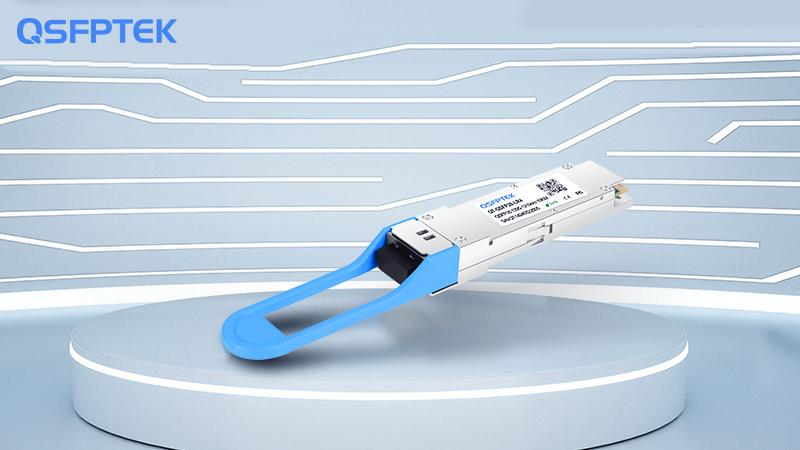
A typical 25GBASE-LR transceiver runs at 25 Gbps over single-mode fiber, using a wavelength around 1310 nm and supporting distances up to 10 km. It usually comes in an SFP28 form factor, which looks almost identical to SFP+ from the outside. That similarity is not just cosmetic — it reflects the idea that 25G is meant to feel like a natural evolution, not a disruptive overhaul.
Why 25GBASE-LR Over Single-Mode Fiber Makes So Much Sense
Most enterprise campuses, carrier access networks, and even many data centers already rely heavily on single-mode fiber. That fiber was often installed years ago with 1G or 10G in mind, but its physical capability is far higher. 25GBASE-LR simply takes advantage of that unused potential.
Instead of pulling new fiber, organizations can often upgrade from 10G LR to 25G LR simply by changing transceivers and, in some cases, line cards or switch ports. From a project management point of view, that’s huge. No construction work, no downtime caused by cabling changes, and no messy coordination with building management.
The 10 km reach also hits a very comfortable range for real-world layouts. It easily covers multi-building campuses, warehouses, logistics hubs, industrial parks, and metro-style access networks. It’s far enough that you rarely feel constrained, but not so far that you’re paying for optical power you don’t actually need.
Common Deployment Scenarios for 25GBASE-LR
One of the most common use cases for 25GBASE-LR is in data center access and aggregation. Servers have been adopting 25G network interface cards at a steady pace, especially in virtualization clusters and storage-heavy environments. A server with dual 25G ports feeding into a top-of-rack switch quickly becomes the new normal in modern racks.
From the access layer, 25GBASE-LR is used for uplinks to aggregation or spine switches, especially when those uplinks must travel across a facility or between different buildings on a campus. Compared to running four separate 10G links, a single 25G LR link simplifies both the cabling and the logical design.
In carrier and ISP networks, 25GBASE-LR is showing up in access rings and edge aggregation. It offers a nice step up from 10G without jumping straight into 100G, which can be overkill for many access scenarios. For providers gradually increasing bandwidth per customer or per node, 25G feels like a very measured upgrade.
25GBASE-LR vs 10GBASE-LR and 100G Optics
It’s impossible to talk about 25GBASE-LR without comparing it to 10GBASE-LR. From a functional point of view, the two look very similar: both run on single-mode fiber, both target the same 10 km range, and both are widely used for campus and aggregation links. The difference is simply capacity. 25G gives you 2.5× the bandwidth in roughly the same physical footprint.
Compared with 100G optics, 25GBASE-LR is far cheaper and easier to deploy at the edge. 100G makes sense in the core or spine, but pushing 100G all the way to every server or access switch is often unnecessary and expensive. 25G fills that middle ground where more speed is needed, but not at any cost.
Power, Heat, and Port Density Considerations
A typical 25GBASE-LR SFP28 module consumes somewhere around 1.5 to 2 watts. That’s slightly higher than a 10G LR module, but still very manageable in dense switch environments. From a thermal perspective, most modern switches are designed to handle full populations of 25G ports without special cooling tricks.
Port density is another strong point. Because SFP28 ports are compact, you can pack a large number of 25G connections into a single switch. This allows very high bandwidth per rack or per aggregation node without moving to much larger chassis-based systems.
Operational Stability and Interoperability
One of the reasons 25GBASE-LR gained traction so quickly is that it builds on very familiar optical principles. Network engineers who are comfortable with 10G LR immediately understand 25G LR. The same connector types, similar optical power ranges, similar troubleshooting workflows — it all feels familiar.
Interoperability between vendors is also generally good. Because 25G is now well established, most major switch vendors support standard-compliant SFP28 LR modules without drama. This gives operators flexibility in sourcing and helps keep costs competitive.
Why 25GBASE-LR Is Still Spreading in 2025
Even though 100G and beyond dominate the headlines, 25GBASE-LR continues to spread quietly through real networks. Server speeds keep increasing, virtualization densities keep rising, and storage traffic keeps growing. In many places, 10G simply isn’t enough anymore — but 100G is still too much.
25GBASE-LR fits neatly into that gap. It delivers a meaningful bandwidth upgrade, keeps costs and power in a reasonable range, and works with fiber that’s already in the ground.
Conclusion
25GBASE-LR is not about flashy innovation. It’s about practical, incremental progress. By delivering 25G over familiar single-mode fiber up to 10 km, it gives network operators a clean, low-risk upgrade path from 10G without forcing them into 100G economics. For access, aggregation, and distributed networks of all kinds, 25GBASE-LR has become one of the most sensible building blocks of modern Ethernet.
