

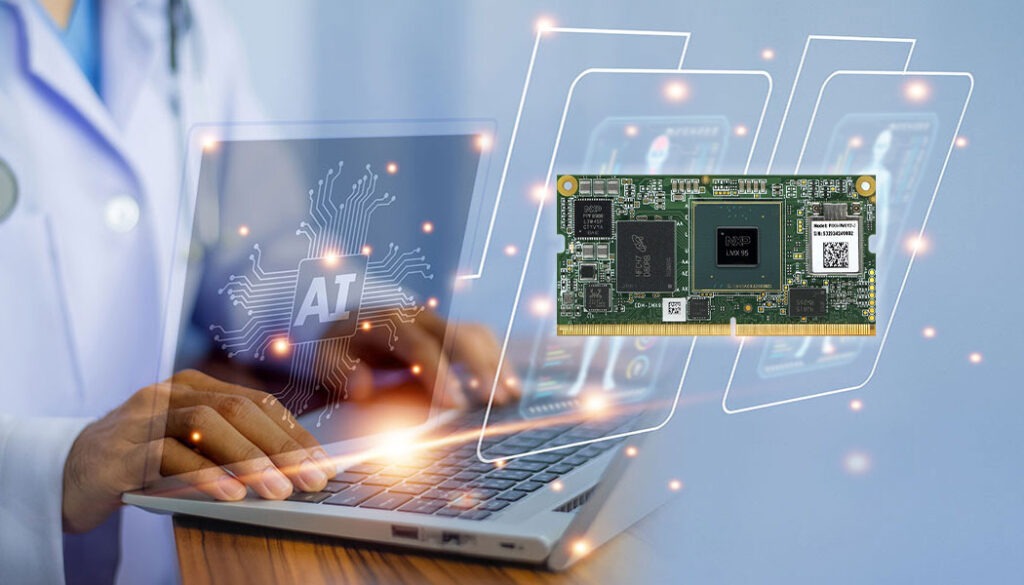
Healthcare is one of the most promising and challenging domains for edge AI. From portable diagnostics and patient monitors to smart imaging terminals and home‑care devices, there is growing demand for systems that can analyze data locally, respond in real time, and still integrate safely with hospital information systems and cloud‑based services. Achieving this requires a careful balance between computational ambition, regulatory constraints, and user trust.
Local processing addresses several concerns at once. Running models on the device reduces latency for critical alerts, such as detecting arrhythmia patterns or abnormal vital signs. It also limits the amount of raw patient data that needs to leave the device, easing privacy concerns and reducing dependence on continuous network connectivity. However, healthcare devices operate under strict safety and performance requirements, and their algorithms often need to be explainable and traceable over long periods.
This is where deterministic behavior and predictable platforms become important. Heterogeneous SoCs that combine application processors, real‑time cores, and NPUs allow designers to segregate safety‑critical functions from higher‑level analytics and user interfaces. For example, a monitoring device might run its core signal‑processing and alarm logic on a microcontroller domain, while an application processor handles UI and AI‑based risk scoring. Using well‑supported module families based on processors like the i.MX 8M Plus or i.MX95 provides an additional layer of stability: hardware and low‑level software can be treated as a known baseline across device versions.
Regulatory pathways further encourage platform reuse. Certifying a medical device involves extensive documentation and testing of both hardware and software. When multiple products share a common edge computing platform and operating system stack, much of this evidence can be reused or adapted rather than recreated from scratch. Long‑term availability and clear migration paths are essential; a device still in service a decade from now must be supportable with compatible components and security updates.
Trust also extends to end users—clinicians, caregivers, and patients—who interact with these devices. Edge AI systems must communicate their decisions clearly and handle failures gracefully. Hardware platforms with support for secure boot, encrypted storage, and robust update mechanisms underpin this trust by reducing the likelihood of tampering or silent malfunction. They also enable controlled rollout of algorithm improvements, which can be critical as medical knowledge and regulatory expectations evolve.
In summary, healthcare edge devices represent a convergence of AI capability, safety engineering, and long‑term stewardship. Platforms that offer balanced performance, strong security primitives, and stable ecosystems give manufacturers a better chance of navigating this convergence successfully. The goal is not simply to embed AI into devices, but to do so in a way that is compatible with the clinical, regulatory, and ethical realities of modern healthcare.
